 EN
Mixed Flow Fan Regular Lubrication Maintenance Method Extends Fan Impeller Service Cycle
A mixed flow fan often runs quietly for months, then begins to reveal small warning signs: a warmer bearing housing, a faint change in tone, or vibration that was not present at handover. In a plant or building ventilation system, these details deserve attention. Regular lubrication does not directly “oil the impeller,” but it protects the mixed flow fan bearing system and shaft support that keep the impeller aligned. Good bearing condition helps the impeller maintain its intended running clearance and reduces the chance that rubbing, imbalance, or an unplanned shutdown will shorten its usable service cycle.
From a facility-maintenance perspective, the useful question is not simply how often to add grease. It is whether the correct lubricant, quantity, cleanliness, and interval are being applied to this specific mixed flow fan under its real duty. The nameplate, bearing manufacturer information, and fan manual should take priority over any general schedule.
Why lubrication affects impeller service cycle
The impeller is mounted on a shaft, and the mixed flow fan shaft is supported by bearings. When bearing lubrication is inadequate, contaminated, incompatible, or excessive, friction and heat can rise. Bearing wear can then permit shaft movement or transmit vibration through the mixed flow fan assembly. Over time, that movement may contribute to abnormal blade-to-casing contact, loosened fasteners, fatigue at connections, and reduced mixed flow fan airflow stability.
There is an important limit here: lubrication cannot correct a bent shaft, damaged impeller, incorrect installation, or duct-system problem. It is one part of a broader mixed flow fan preventive-maintenance routine. Still, when the mixed flow fan uses regreasable bearings, a controlled lubrication method is among the simplest ways to protect the support system before damage reaches the impeller.
Start with the right maintenance information
Before scheduling a lubrication task, collect the mixed flow fan model, bearing designation, motor and drive arrangement, operating speed, run hours, ambient temperature, and installation orientation. A mixed flow fan installed in a clean, conditioned plant room will not necessarily need the same interval as one exposed to heat, dust, moisture, or round-the-clock duty.
- Use the grease type and relubrication interval specified by the mixed flow fan or bearing manufacturer.
- Confirm whether the bearings are sealed-for-life or regreasable; do not force grease into a bearing arrangement not designed for it.
- Record the product name or compatibility information before changing grease types.
- Identify the grease inlet and any relief path so old grease has a controlled place to exit.
For many maintenance teams, the practical improvement is to put these details in an asset record instead of relying on a calendar reminder alone. Duty conditions change, and the maintenance interval should be reviewed when operating hours, temperature, or vibration trend changes materially.
Safe preparation before greasing a mixed flow fan
Isolate the electrical supply, apply the site lockout/tagout procedure, and verify that the impeller has stopped completely. Wait for hot components to cool where necessary. Remove guards only when the mixed flow fan equipment is safe to access, and keep loose clothing, wipes, and tools away from the mixed flow fan inlet and outlet.
Cleanliness matters as much as the grease itself. Wipe the fitting and the coupler before connecting the grease gun. Dirt introduced through a fitting can undermine the purpose of the job. Check that the grease gun is clearly labeled with the intended lubricant; mixing incompatible greases may reduce consistency and oil separation performance.
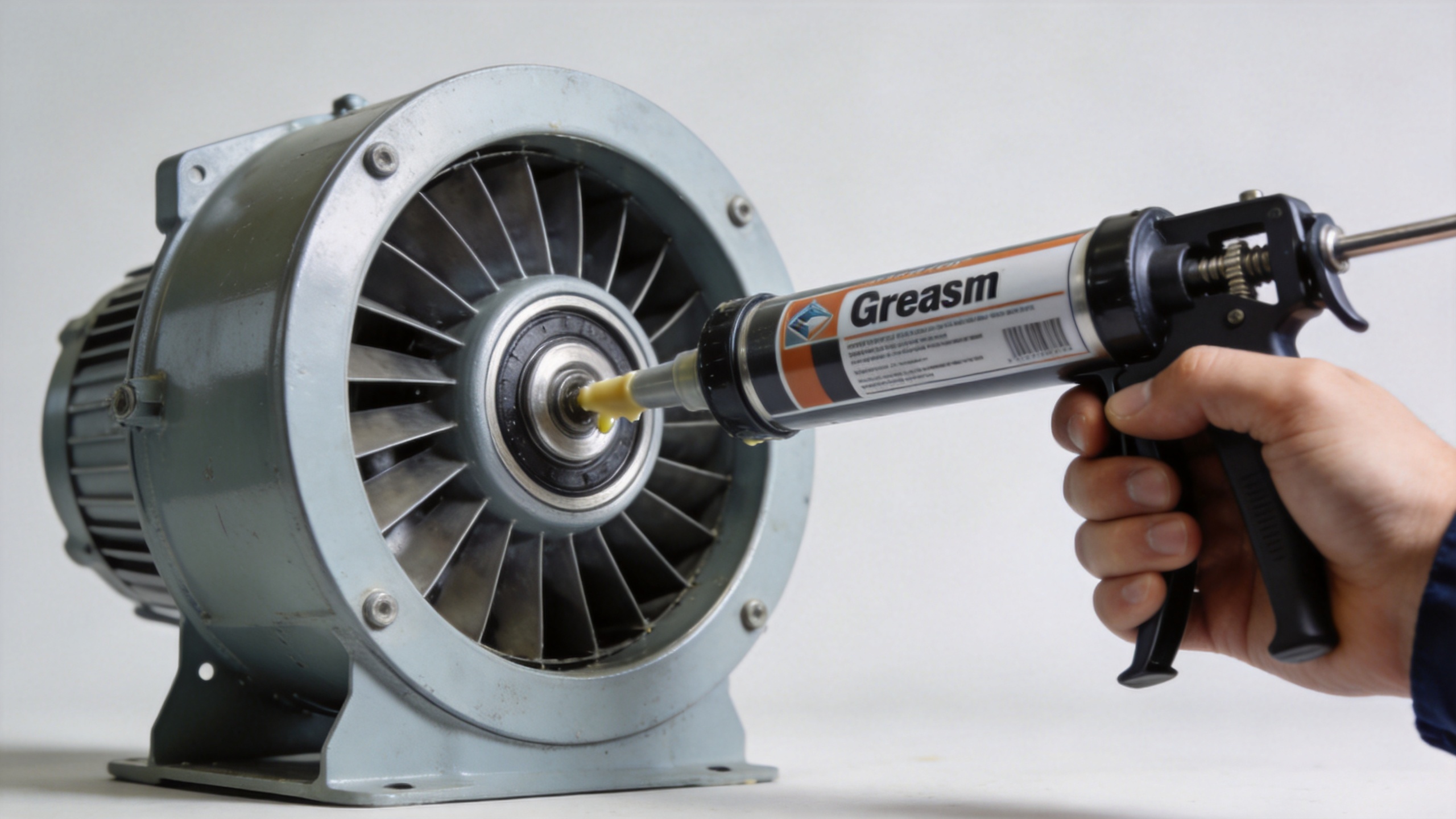
A controlled lubrication procedure
- Inspect first. Look for leaked grease, discolored residue, damaged fittings, loose mounting hardware, belt dust where applicable, and signs of impeller rubbing. Listen for prior operating notes about noise or vibration.
- Check the relief route. Open or confirm the prescribed relief point if the design requires it. This avoids packing old grease and pressure into the bearing housing.
- Add grease slowly. Use the manufacturer-specified amount. Apply small, controlled strokes rather than a rapid burst. If the manual does not specify a quantity, obtain the bearing guidance instead of estimating by feel.
- Watch for abnormal resistance. Stop if the gun suddenly requires excessive force, grease exits from an unexpected point, or the housing appears overfilled. Investigate the passage or fitting before continuing.
- Remove excess externally. Wipe away expelled old grease and clean the area around the fitting. Do not leave grease where it can collect dust or contaminate nearby components.
- Reassemble and restart safely. Refit guards, remove tools, and release lockout/tagout only under the site procedure. Observe the mixed flow fan during the first mixed flow fan operating period for temperature, noise, and vibration changes.
Do not over-grease
More grease is not more protection. Excess lubricant can churn, raise bearing temperature, push through seals, and attract contamination. It can also create a misleading impression that a mechanical problem has been fixed. If a bearing repeatedly throws grease, becomes hot after lubrication, or shows increasing vibration, treat that as an inspection trigger rather than adding more grease.
Similarly, do not extend intervals only because the fan still runs. Lubricant condition is influenced by speed, loading, temperature, contamination, and time. A condition-based review using mixed flow fan operating observations is usually more useful than an unexamined one-size-fits-all interval.
Pair lubrication with an impeller-focused inspection
A mixed flow fan lubrication stop is a good opportunity to look at the rest of the mixed flow fan rotating assembly. With the power isolated, inspect the impeller for buildup, corrosion, cracked welds, loose blades, missing balance weights, and signs of contact with the casing. Check mounting bolts, isolation mounts, guards, and flexible connections. Dust buildup can change balance even when the bearings are properly greased.
After restart, document the date, lubricant, amount, technician, run hours, observed temperature, and any unusual noise or vibration. A short record creates a baseline. The next technician can see whether the condition is stable or whether a trend is developing.
When lubrication should lead to a deeper check
Schedule a qualified mixed flow fan inspection if you notice persistent vibration, a rapid temperature rise, metallic noise, repeated seal leakage, visible shaft movement, damaged impeller surfaces, or reduced airflow with no obvious system change. These symptoms may involve alignment, balance, bearing damage, drive tension, electrical issues, or duct resistance. Grease alone is not a repair strategy.
Make the routine sustainable
For a mixed flow fan fleet, the strongest program is simple enough to repeat: use the approved lubricant, follow the model-specific interval and quantity, keep fittings clean, inspect before and after mixed flow fan greasing, and trend what you observe. This disciplined approach supports bearing life and helps protect the shaft and impeller from avoidable secondary damage. For mixed flow fan and ventilation equipment, fire dampers, and fans, Jinan Hongpeng Ventilation Equipment Co., Ltd. can help purchasers discuss equipment documentation and maintenance requirements with their project team.
 Hot News